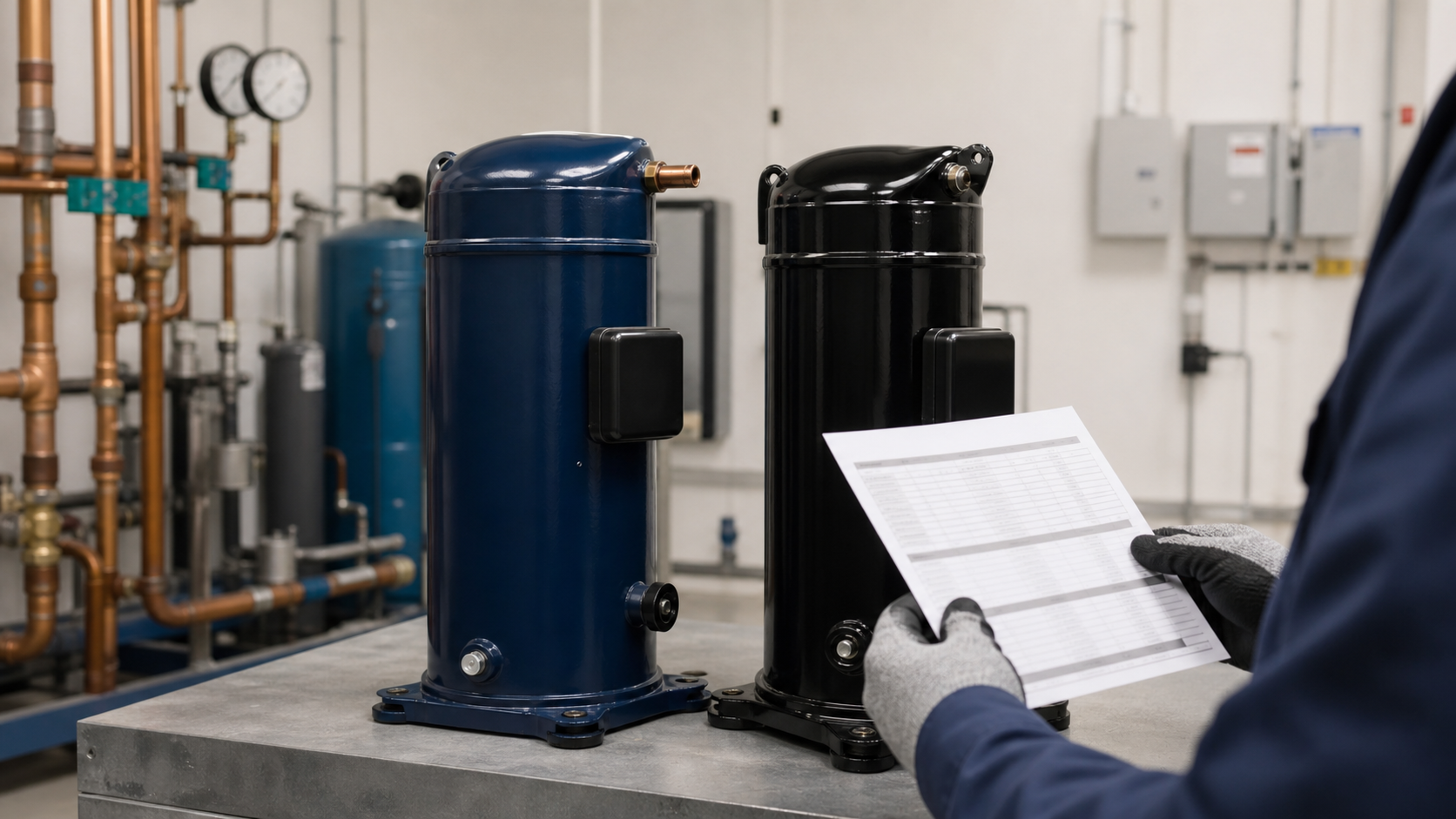
A failed compressor creates understandable urgency, but a safe Copeland scroll compressor replacement begins with identification rather than a visual match. Scroll units that look similar can have different approved refrigerants, electrical configurations, operating envelopes and control requirements. Collecting the right information before ordering helps avoid a second shutdown and protects the new compressor at start-up.
Start with the complete model and nameplate
Photograph the full nameplate and record the complete model code, serial number, voltage, phase, frequency and refrigerant shown on the original unit. The complete code matters more than a partial reference or nominal capacity. If the plate is missing or damaged, provide clear pictures of connections, mounting points and the equipment model together with any service documentation.
Match the application, not only the capacity
Confirm whether the compressor serves air conditioning, a heat pump, medium-temperature refrigeration, low-temperature refrigeration or process cooling. Compare capacity at the actual evaporating and condensing conditions, including expected ambient temperature and part-load operation. A compressor that is too large can short cycle; one that is too small may run continuously. The final selection must remain within the manufacturer approved envelope for the exact refrigerant.
Check electrical and control compatibility
Verify the supply voltage under load, phase, frequency, starting method and protection arrangement. For three-phase equipment, inspect phase balance and the control sequence; for single-phase equipment, confirm the specified start components. In digitally controlled or inverter applications, the compressor, drive and controller must be an approved combination. Do not assume that a similar terminal layout means electrical compatibility.
Compare installation details and protect the new unit
Before ordering, compare suction and discharge connection sizes and positions, mounting footprint, height, oil type, crankcase heater and required accessories. At replacement, the system fault must also be corrected: inspect airflow, refrigerant feed, contamination, return gas conditions, contactors and controls. Evacuate, charge and commission according to the applicable manufacturer documentation. A new compressor cannot compensate for a blocked condenser, unstable expansion device or repeated rapid starts.
What to include in a quote request
Send the complete model code, refrigerant, electrical supply, application, photos of the nameplate and the reason for replacement. Add measured suction and discharge conditions when available. RCP can help identify an appropriate Copeland scroll compressor or replacement option and the relevant accessories. Final suitability should always be confirmed against the manufacturer documentation and the real system conditions.