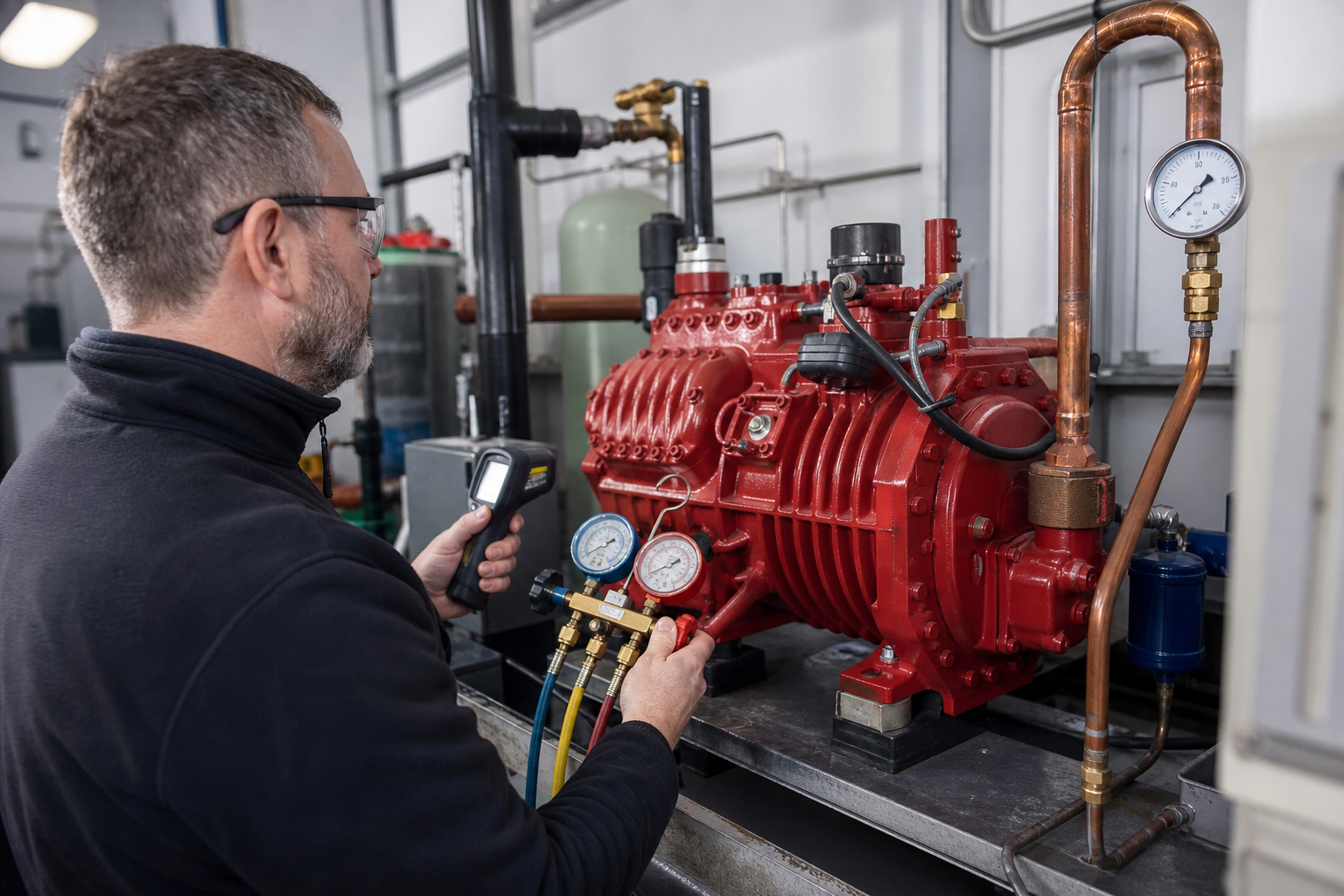
High discharge temperature is one of the warning signs that service teams take most seriously on Frascold compressors used in cold rooms, condensing units and commercial refrigeration racks. The temptation is to order a replacement quickly, especially when the plant still runs but shows overheating risk. Yet many Frascold compressors that appear to run too hot are responding to system conditions around them: poor condenser performance, unstable superheat, low return gas cooling, restriction in the liquid line or excessive compression ratio. A structured troubleshooting sequence helps reduce repeat failures and protects the quote decision.
1. Confirm the temperature reading and where it is measured
Before drawing conclusions, verify whether the high discharge temperature is real and whether the sensor or thermometer is placed correctly. A badly positioned probe, poor thermal contact or a control threshold set too aggressively can create alarm behavior that looks like severe overheating. Service teams should compare controller readings with direct measurement and confirm whether the temperature spike is constant, startup related or linked only to certain load conditions.
2. Check condenser cleanliness, airflow and condensing pressure
One of the most common causes of high discharge temperature on a Frascold compressor is elevated condensing condition. Dirty condensers, fan problems, blocked airflow or hot ambient around the unit increase compression work and push discharge temperatures up. In many service calls the compressor is blamed because it is the component that overheats, while the actual issue begins on the heat rejection side. Condensing pressure should therefore be reviewed before any deeper compressor conclusion is made.
3. Review superheat, evaporator feed and return gas cooling
If the evaporator is underfeeding, the suction gas can become too hot and too thin to cool the compressor properly. Excessive superheat or unstable expansion control often drives discharge temperature upward, especially on systems that already work near difficult operating limits. On Frascold applications, checking return gas condition is essential because the compressor may still pump and cool the room while its thermal margin is already disappearing. A unit that cools does not automatically mean a unit that is safe.
4. Verify refrigerant charge behavior, restrictions and non-condensables
Undercharge, partial liquid line restriction, clogged filter drier or non-condensable gases in the circuit can all distort pressures and raise discharge temperature. These faults are dangerous because they may imitate internal compressor distress while actually coming from the refrigerant circuit. Looking only at one pressure value is not enough. Charge behavior, subcooling, sight glass condition and pressure stability under load all contribute to a more reliable diagnosis.
5. Consider compression ratio, application duty and oil condition
A Frascold compressor selected for the wrong duty or forced into extreme compression ratio will run hotter than expected even if it is mechanically sound. In cold room and low-temperature applications, this can happen after changes in setpoint, refrigerant, fan control or ambient exposure. Oil condition also matters: degraded or diluted oil reduces thermal protection and lubrication reserve. When discharge temperature is high, model suitability and oil quality should be checked together with live operating data.
6. Use the overheating event to diagnose the system, not only the compressor
If a Frascold compressor has already suffered internal valve damage or repeated thermal stress, replacement may be required. But replacing the shell before understanding why discharge temperature climbed so high often leads to a second failure. The better approach is to treat overheating as a system event first: review condenser side, feeding stability, charge condition and application envelope before deciding on replacement. That sequence protects both uptime and the commercial accuracy of the spare parts quote.
The practical message is clear: a Frascold compressor with high discharge temperature should trigger a full operating review, not a rushed order alone. By confirming the real temperature, checking condensing conditions and verifying superheat, charge behavior and application duty, service teams can separate a real compressor failure from a system problem faster. If a replacement compressor or urgent spare parts are still needed, that diagnosis helps ensure the next unit is matched and started under safer conditions.