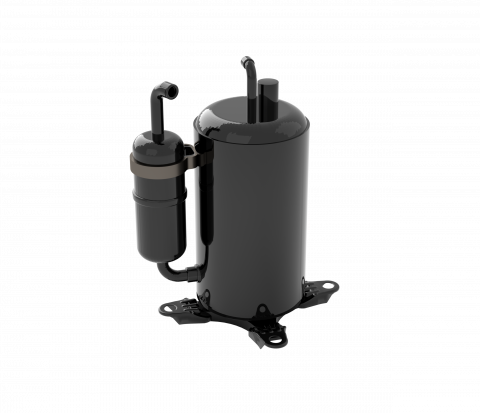
Low-temperature refrigeration puts more stress on the whole system, not only on the compressor. That is why Panasonic scroll compressors installed on freezers, cold rooms and packaged condensing units often show symptoms that look like compressor failure even when the root cause is elsewhere. A more disciplined diagnosis helps service technicians protect the replacement budget, shorten downtime and avoid exposing the next compressor to the same unresolved condition.
1. Confirm that the installed model really matches low-temperature duty
The first check is basic but critical: verify that the installed Panasonic or former Sanyo model belongs to the correct application range. Distributor listings for Panasonic or Sanyo scroll families show clear differences between high-temperature and low-temperature references. Models such as CSCN373L8A and CSCN753L8H are presented for low-temperature R404A work, while many other Panasonic references are grouped as high-temperature units. If the system received the wrong duty model during a previous repair, the compressor can run hot, lose capacity or fail early even when other adjustments seem reasonable.
2. Look at superheat and return gas conditions before blaming the compressor
Low-temperature systems are especially sensitive to incorrect feeding and unstable suction conditions. If the evaporator is starved, the Panasonic scroll may overheat and lose cooling performance. If the system floods back, oil dilution and mechanical stress can appear quickly. A technician should therefore confirm stable superheat, dry vapor at the compressor and realistic return gas temperature before deciding that the compressor itself is the defective part.
3. Check condensers, evaporators and airflow under real load
On freezer and low-room applications, heat exchange problems often create compressor complaints that are actually system complaints. Dirty condensers, iced evaporators, blocked airflow, failing fan motors or poor room loading can shift suction and condensing conditions enough to overwork the Panasonic scroll. The compressor then becomes the visible victim of an airflow or heat rejection issue. Real operating load matters here, because a system that looks acceptable during a quick test can behave very differently once product load and ambient conditions rise.
4. Verify electrical quality, especially on three-phase installations
Many Panasonic scroll compressors in commercial refrigeration operate on three-phase supply, so voltage imbalance, weak contactors, loose terminals and poor protection logic should be checked early. A compressor that stops on internal protection or struggles during restart may actually be reacting to electrical stress from upstream components. Measuring live voltage under load is more useful than trusting nominal values on paper. Repeated nuisance trips are often a control or supply quality problem before they become a true compressor problem.
5. Review oil return and piping logic on long or difficult circuits
Low-temperature refrigeration usually makes oil return less forgiving. Long risers, oversized suction lines, poor trap design or unstable load patterns can keep oil away from the compressor for too long. When lubrication margin drops, the Panasonic scroll may become noisy, run hot or fail repeatedly after replacement. That is why diagnosis should include pipe layout, not only pressures and amperage. In difficult circuits, the piping design can be as important as the compressor model itself.
6. Use the replacement event as a system reset, not as a parts swap only
If a Panasonic scroll compressor really must be replaced, the job should not stop at changing the shell. The service team should also review contamination risk, filter driers, refrigerant condition, control settings and the original cause of failure. Otherwise the new compressor enters the same environment that damaged the first one. In commercial refrigeration, avoiding the second failure is often worth more than saving a small amount of time on the first intervention.
The practical message is simple: low-temperature Panasonic scroll troubleshooting is rarely solved by checking one pressure and ordering one replacement. It requires matching the correct duty model, stabilizing feeding conditions, reviewing airflow and electrical quality, and confirming that oil can reliably return to the compressor. When those checks are handled in sequence, service teams usually identify the real bottleneck faster and protect both uptime and replacement cost more effectively.