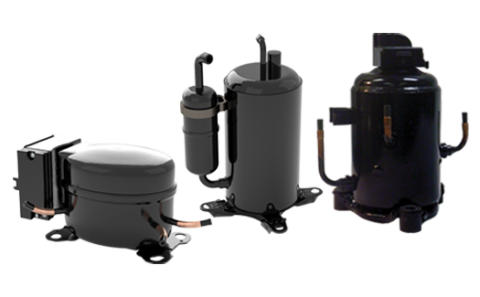
Panasonic scroll compressors continue to attract demand in commercial refrigeration because many installers, OEMs and service companies still work with both Panasonic and former Sanyo references in the field. When a replacement is needed, the fastest path is not guessing from compressor size alone. The safer path is matching the application temperature range, refrigerant, electrical supply and model family before ordering. That is especially important when the system must return to service quickly and there is little tolerance for a second intervention.
1. Start from the Panasonic or Sanyo model code already on the unit
Many buyers search for Panasonic scroll compressors with mixed Panasonic and Sanyo naming because installed units still carry legacy references. That detail matters. Distributor catalogs for Panasonic or Sanyo SB and SC scroll series list specific model codes, and those codes usually reveal much more than a generic description such as 7 HP scroll compressor. If the original label is still readable, begin from that exact reference before comparing alternatives.
2. Separate high-temperature and low-temperature applications first
Before checking price or availability, define whether the compressor works in a high-temperature, medium-temperature or low-temperature refrigeration duty. This avoids one of the most common replacement errors. Panasonic or Sanyo distributor listings group scroll models by application. For example, high-temperature references such as CSBS235H38A, CSBP205H38A and CSCP510H38B are clearly presented as high-temperature models, while models such as CSCN373L8A and CSCN753L8H are listed for low-temperature work. That distinction should drive the short list immediately.
3. Confirm refrigerant compatibility instead of assuming the family is interchangeable
Panasonic scroll selections are often filtered by refrigerant because the same brand family spans different refrigerant platforms. Current distributor listings for Panasonic or Sanyo SB and SC series include examples for R134a, R404A, R407C and R410A, while several high-temperature models are described specifically as R410A Hi-COP versions. In practice, this means a replacement decision should never be based only on capacity or pipe size. Refrigerant compatibility has to be checked from the model code and application sheet first.
4. Check supply voltage and phase before releasing the order
Electrical matching is another point that slows projects down when it is ignored until the last minute. Panasonic or Sanyo scroll catalog pages commonly show single-phase and three-phase configurations across different references. A compressor that looks right mechanically can still be wrong for the installation if the supply is not matched correctly. On urgent cold room and condensing unit jobs, confirming voltage and phase before shipping is often what prevents wasted time on site.
5. Use SB and SC family information to narrow the search faster
For many buyers, the practical challenge is not understanding scroll technology. It is reducing a long list of similar Panasonic references to the few that fit the real duty. The SB and SC series pages are useful because they quickly show whether a model sits in a high-temperature R407C line, a high-temperature R410A Hi-COP line, an inverter-related reference or a low-temperature R404A application. That makes the family page a useful commercial checkpoint before technical confirmation and quotation.
6. Replacement should include the surrounding risk, not just the compressor body
A good Panasonic scroll compressor replacement decision also checks why the original unit is being changed. If the previous compressor failed because of floodback, overheating, voltage instability, dirty condensers or oil return problems, a correct new model can still fail early. The replacement process should therefore combine model verification with a quick review of refrigerant conditions, electrical quality and general system cleanliness. That approach protects both delivery time and customer trust.
For buyers sourcing Panasonic scroll compressors, the commercial advantage comes from combining exact model identification with application logic. Panasonic and former Sanyo references remain common in refrigeration plants, condensing units and packaged systems, so fast support depends on recognizing the right family, refrigerant and duty before ordering. When the job also requires spare parts, technical support or an urgent quotation for an equivalent replacement compressor, that structured selection method helps reduce downtime and avoids avoidable repeat work.