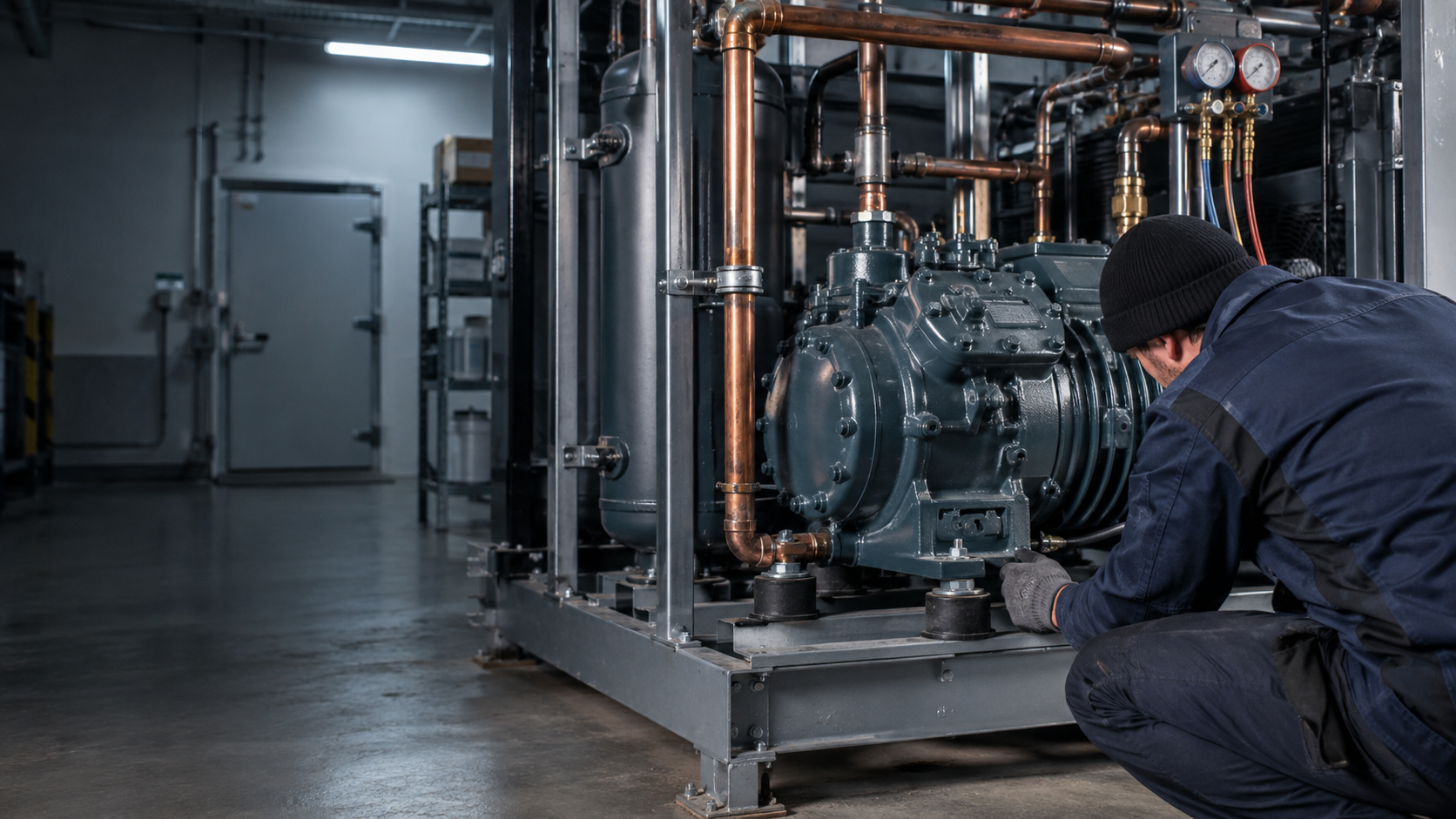
New vibration, rattling or abnormal compressor noise deserves attention, but it is not automatically proof of an internal compressor failure. Pipework resonance, loose mounting hardware, damaged isolators, unstable operating conditions and liquid return can all create sounds that appear to come from the compressor. Work on refrigeration and electrical equipment must be performed by qualified personnel using safe isolation and manufacturer instructions.
Describe the symptom and operating moment
First establish whether the sound occurs at startup, during pull-down, after defrost, at a specific load or continuously. Note whether it is a rattle, metallic knock, pulsation, buzzing or vibration transferred to pipework. The timing matters: a sound that appears only during startup has different likely causes from one that follows a pressure change or a fan cycle.
Inspect mounting, pipework and external components
With equipment safely isolated, inspect compressor feet, rubber isolators, base-frame bolts, brackets and pipe clamps. Copper lines must not touch panels or each other, and unsupported long runs can resonate. Also inspect condenser and evaporator fans, contactors and fan guards; a nearby component can transmit vibration to the compressor shell.
Review system conditions before condemning the compressor
Liquid floodback, unstable expansion control, excessive compression ratio and rapid cycling can create abnormal noise and mechanical stress. Record suction and discharge pressure, line temperatures, current, voltage under load and control sequence under stable conditions. A noisy unit that has normal mounts but poor refrigerant feed or liquid return needs a system correction, not an immediate parts swap.
When replacement is justified
Internal mechanical damage, broken valves or severe bearing damage can require replacement, but the root cause must be corrected first. After any serious event, inspect oil condition and contamination risk, then verify piping support, controls and operating measurements before startup. For an accurate quote, send RCP the model code, refrigerant, electrical data, application and a clear description of the measured symptom.