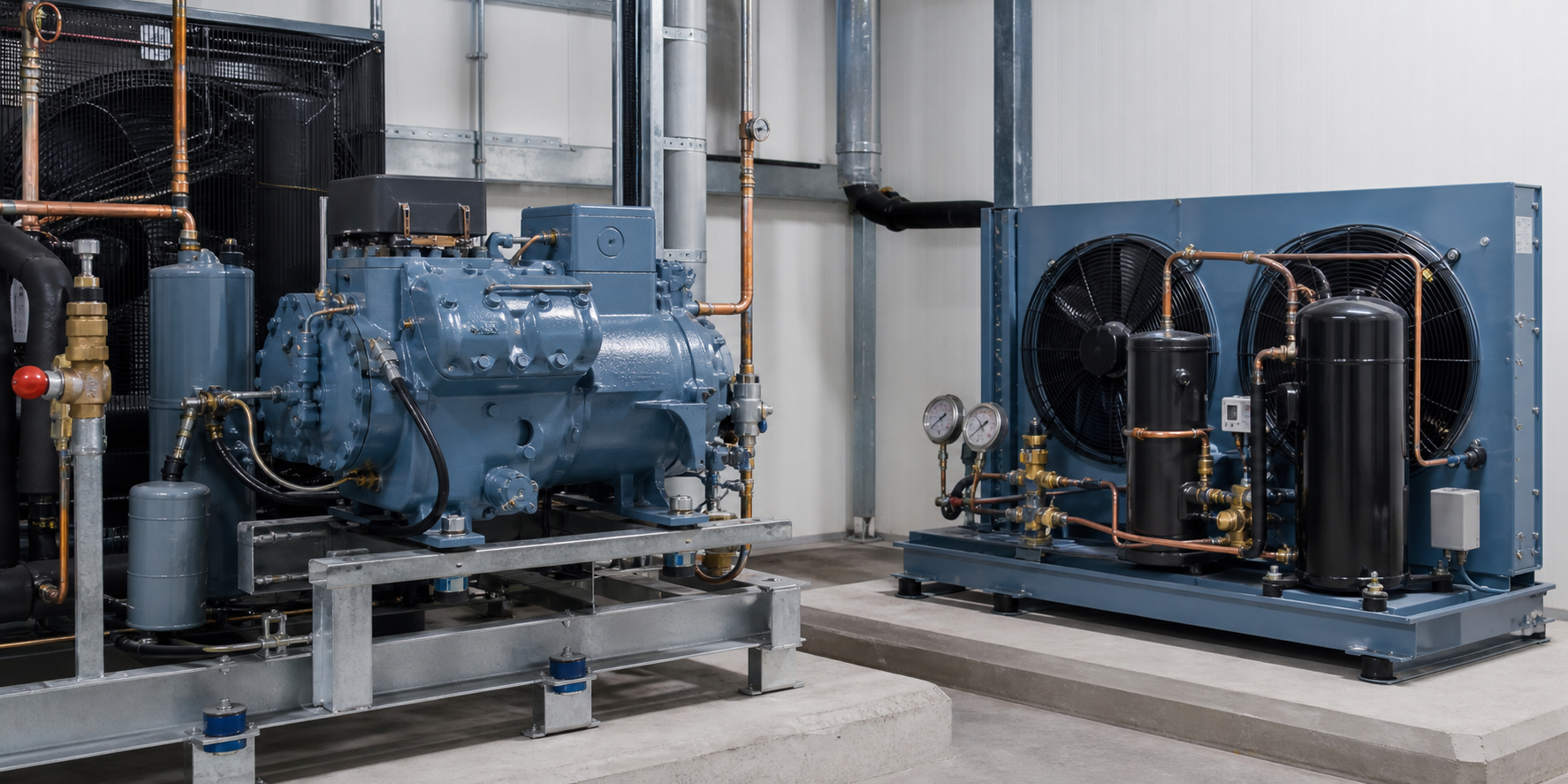
When a cold room, condensing unit or commercial refrigeration plant needs a new compressor, many buyers immediately compare only capacity and price. In reality, the choice between a semi-hermetic compressor and a scroll compressor has wider consequences for service access, part replacement, system flexibility and long term operating cost. The right decision depends on the application, not on a generic preference for one technology.
1. Start from the application, not from the compressor format
Semi-hermetic compressors are often selected for applications where serviceability, robust mechanical construction and component replacement matter. Scroll compressors are frequently preferred where compact size, quieter operation and simplified packaged systems are important. A low temperature cold room, a supermarket condensing unit and an industrial refrigeration pack may all need very different priorities even when the nominal capacity looks similar.
2. Evaluate load profile, operating range and control strategy
If the plant works with variable load, frequent pull-down phases or demanding temperature conditions, compressor behavior across the operating envelope becomes critical. Semi-hermetic compressors can offer strong flexibility in many service scenarios, while scroll compressors often fit compact commercial systems with stable and repeatable duty. Capacity control, inverter logic, refrigerant choice and return gas conditions should all be checked before selecting the final compressor family.
3. Consider installation layout and maintenance access
A compressor is never installed alone. Pipe routing, receiver position, oil management, available footprint and service clearance influence which solution is more practical on site. Semi-hermetic units can be attractive when technicians need access to serviceable components and a clearer maintenance path. Scroll compressors can simplify certain installations where space is tighter and the plant architecture favors packaged simplicity.
4. Compare downtime risk, spare parts logic and replacement speed
From a commercial point of view, the cost of downtime can easily exceed the price difference between two compressor types. Buyers should therefore think about lead time, spare parts availability, field replacement speed and how easily the chosen model integrates into the existing system. A compressor that is slightly cheaper on paper may still become the more expensive option if it delays restart or complicates service interventions.
5. Check refrigerant compatibility and future service needs
The selected compressor should also make sense for the refrigerant in use today and for the service strategy planned over the next years. Oil type, approved refrigerants, protection devices and electrical configuration all need confirmation before ordering. This is especially important when replacing an older compressor in an existing installation where the original system conditions may no longer be ideal.
6. Use the quote stage to reduce technical and commercial mistakes
The best compressor choice usually comes from matching application temperature, refrigerant, voltage, footprint and expected service conditions in one clear request. That is why a detailed quotation stage matters. Sharing model references, nameplate data, operating conditions and pictures of the installation reduces the risk of ordering a compressor that fits only on paper. For international buyers, this also helps align spare parts, lead times and logistics before the unit is shipped.
There is no universal winner between semi-hermetic and scroll refrigeration compressors. The better solution is the one that protects uptime, simplifies maintenance and matches the real operating profile of the system. When the selection is treated as an engineering and sourcing decision instead of a simple price comparison, the final result is usually safer for both the installer and the end user.